AI Didn't Steal Your Job. But It Changed Everything Around It.

Last Updated: May 28, 2026
Table of Contents
- The Jobs That Vanished Weren't the Ones We Feared
- The Income Gap Is the Real Story
- What AI Genuinely Does Well (and Where It Falls Apart)
- The Government Piece
- Cockroach Janata Party
- So What Do You Actually Do?
- Frequently Asked Questions
Here's what nobody tells you at the AI conference: the robots didn't show up and clear out the office. What happened instead was quieter, and honestly more uncomfortable. AI crept into workflows, rewired expectations, and left millions of workers asking the same question, am I still necessary?
The short answer is yes. The honest answer is: it depends what you do next.
The jobs that vanished weren't the ones we feared
Every think-piece from 2019 told us surgeons, teachers, and lawyers were next. That didn't happen. The middle layers actually evaporated. The data entry clerk, the junior copywriter pumping out product descriptions, the call center rep answering the same seven questions on a loop. McKinsey's 2025 Global Labour Report put the number of "highly automatable" roles that saw real displacement at around 14% of the workforce in developed economies. Significant. But not the apocalypse.
What replaced those roles? Mostly new ones nobody had a name for three years ago. Prompt engineers. AI auditors. Automation trainers. If that sounds abstract, here's what it looks like in practice: a logistics company near Pune laid off 40 data clerks in 2023, then hired 18 people to manage, verify, and correct the AI that replaced them. Net loss: 22 jobs. Net change in what those jobs involved: total.
The income gap is the real story
This is where I think most AI coverage gets it wrong. The conversation focuses on job counts when the real damage is happening to wages. AI didn't eliminate the customer service industry. It compressed it. Those who remained as workers received more tickets, more pressure, and the same pay or less. Automation didn't liberate them. It stretched them thinner.
Meanwhile, the engineers building the automation systems averaged a 34% salary jump between 2022 and 2025. Same labour market. Completely different outcomes depending on which side of the AI divide you landed on.
That gap is getting harder to close. It’s not so much a skills gap, as an access gap. Retraining programs exist, but they cost time and money most displaced workers don't have. The factory worker in Rajkot who got automated out of his QA job doesn't need a LinkedIn Learning subscription. He needs six months of paid leave and childcare covered. That's a policy problem, not a tech problem.
What AI genuinely does well (and where it falls apart)
- Repetitive, pattern-heavy tasks: AI dominates. AI finds anything with a correct answer it can find in existing data faster and cheaper than humans. There's no point pretending otherwise.
- Judgment calls, client relationships, physical presence, creative risk, emotional nuance: still fully human. A therapist using AI tools to flag at-risk patients is more effective than one who doesn't. A therapist replaced by AI is a disaster waiting to happen.
The uncomfortable truth is that "AI-proof" work isn't a category of job. It's a layer of any job. Every role has a portion that's mechanical and a portion that requires genuine thinking. AI is eating the mechanical part. What remains is more difficult and the systems supporting workers have not kept pace.
The government piece
India added roughly 8 million new workers to the labour force in 2025. The economy created formal jobs for maybe 2 million of them. It's not a new gap. It was there decades before AI. But AI is accelerating it. When a mid-size manufacturer can automate 30% of floor operations with a two-year ROI, that math is hard to argue against. The jobs that would have been entry-level footholds into the formal economy are disappearing before the next generation can grab them.
The people in that gap aren't failing. They're in a system that hasn't decided whether to support them. Subsidies go to automation adoption. Reskilling budgets are a rounding error. Most of the time, the political response has consisted of noise: job statistics that include gig work as employment, announcements that are not followed through on, and a general display of concern without any supporting mechanisms.
Frustration with that gap is exactly why movements like the Cockroach Janata Party are gaining traction. People aren't asking for handouts. They're asking for basic honesty about what the economy actually is versus what they're being told it is.
Cockroach Janata Party
What the name means
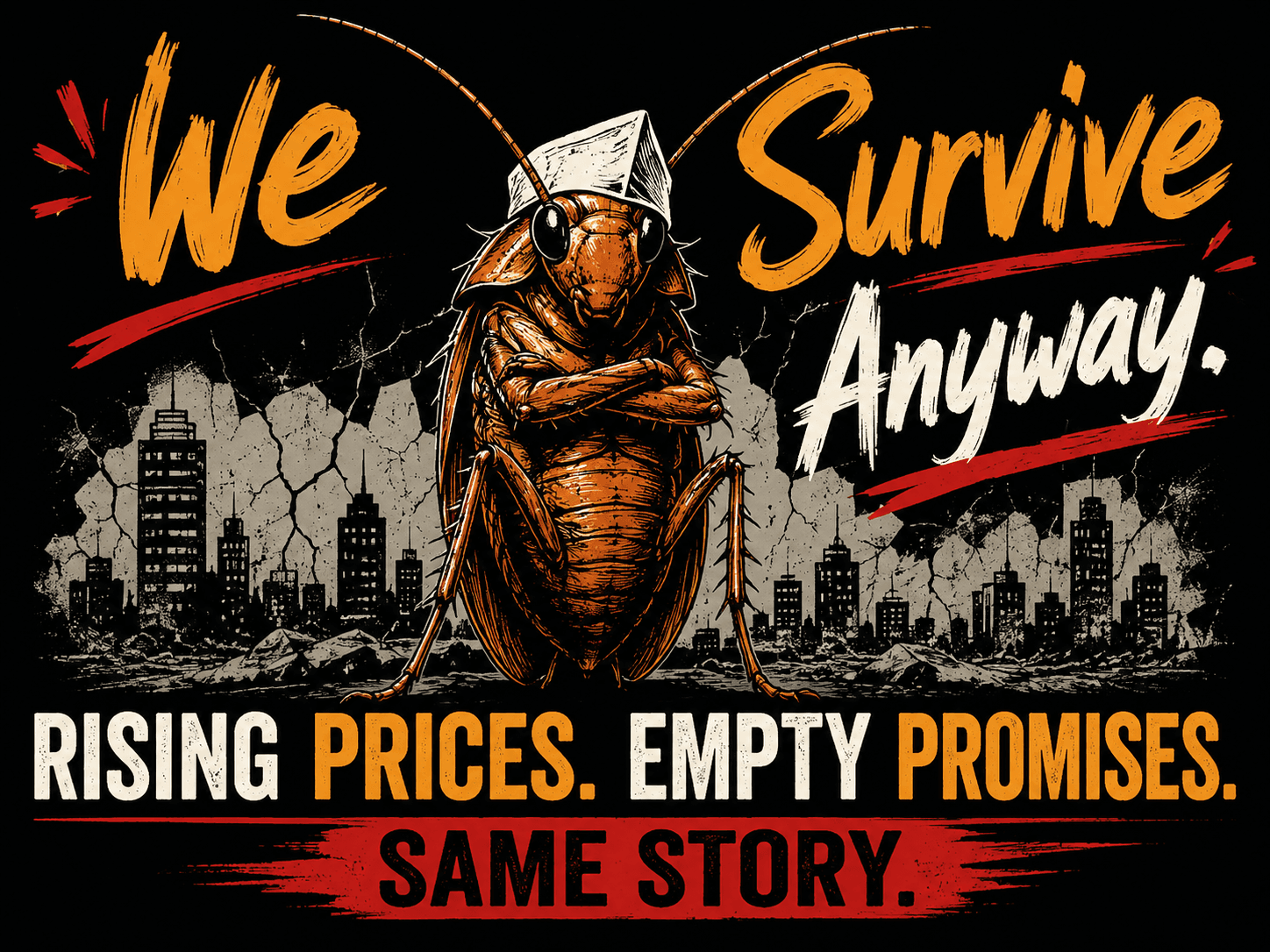
The cockroach framing is deliberate and pointed. Cockroaches survive everything. They outlast floods, neglect, poison, and policy failure. The CJP's core message is: ordinary people have been surviving despite the government, not because of it. The name is both self-deprecating and defiant, and that tension is exactly why it resonates.
Key issue drivers
Issue strength index (self-reported voter surveys, March 2026)
| Issue | Strength Index |
|---|---|
| Unemployment / job creation failure | 9.1 / 10 |
| Fuel and daily essentials cost | 8.7 / 10 |
| Broken pre-election promises | 8.4 / 10 |
| AI / automation displacement anxiety | 7.6 / 10 |
| Informal sector exclusion from benefits | 7.2 / 10 |
| Access to formal credit | 6.8 / 10 |
Crude oil and price spiral: the catalyst for inflation
Brent crude averaged $97/barrel in Q1 2026, up from $71 in 2023. This directly affects transportation costs for India, a net importer, which in turn affects the cost of goods and food. The CJP's specific framing around "effluence" (waste flowing downward to ordinary people) captures something real: profits from cost-saving automation and energy sector margins have not translated into lower prices for end consumers. The burden has moved in one direction.
Cost-of-living pressure index (2020 baseline = 100)
| Item | Increase |
|---|---|
| Petrol / diesel | +58% |
| Cooking oil & pulses | +43% |
| Transport (intercity) | +37% |
| Rental housing (Tier 2 cities) | +29% |
Growth trajectory
In late 2024, the CJP began as social media satire through Twitter threads, short videos, and memes. By early 2026 it had crossed into street-level organising in at least 9 states, with the strongest footprint in Gujarat, Maharashtra, UP, and Bihar. Its demographic core is 18–35 year olds with some education who are either unemployed, underemployed in gig roles, or earning less in real terms than their parents did at the same age.
The movement's refusal to align with any existing party is both a strength and a vulnerability. It maintains credibility by staying outside the system, however, for the time being, that also restricts formal electoral influence. The more interesting question is whether it functions as a pressure valve (letting frustration out without creating change) or a genuine agenda-setter for future electoral cycles.
Strategic risk for incumbents
Movements like CJP rarely win elections. They shift what questions elections get asked on. If the 2028–29 cycle gets fought on real wages, fuel cost, and automation displacement rather than identity and infrastructure optics, that is a terrain change that favours opposition parties willing to engage with economic specifics. Parties that continue to run on promise-heavy, delivery-light campaigns are betting that disillusionment stays diffuse. The CJP's main function is making that bet harder.
So what do you actually do?
If your job is largely mechanical as document processing, basic content, data sorting, entry-level customer support the threat is real and worth taking seriously now rather than reactively. Not because you'll be fired tomorrow, but because the window to move is open right now and it won't stay open forever.
Learn one layer up from what you currently do. Not the AI tools themselves, necessarily. Learn the judgment that sits above them. Understand how decisions get made in your field, not just how tasks get done. That's the layer AI consistently can't replicate and for now, it's where the leverage is.
The workers who are doing fine aren't necessarily more skilled. They're the ones who figured out, early enough, that AI was a tool for them to use rather than a replacement waiting to deploy. That's a mindset shift as much as a skills shift. And it's available to more people than the tech industry wants to admit.